
Note on Probability Density Functions * Intuition. Given 6>0, Pr(X e is equal to the integral of f(x) over Therefore, if € is "small" f(x) Pr(X e Even if f(x) is not a probability, it can be used to obtain relative probability of one value Xl over in that Pr(X € [Xl-€, Xl +e])/Pr(X € [X2-e, +6]) 26 Thus, if f(X1) is larger than f(X2), then values of X close to Xl are more likely than values close to ( * ) Advanced material
Question
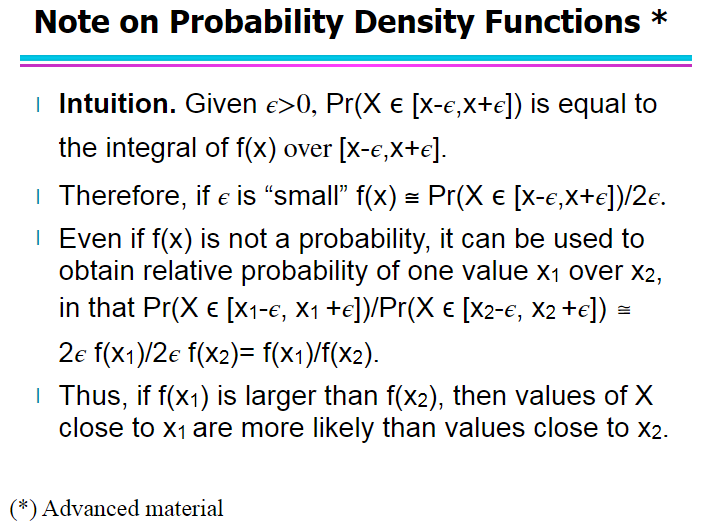
Note on Probability Density Functions * Intuition. Given 6>0, Pr(X e is equal to the integral of f(x) over Therefore, if € is "small" f(x) Pr(X e Even if f(x) is not a probability, it can be used to obtain relative probability of one value Xl over in that Pr(X € [Xl-€, Xl +e])/Pr(X € [X2-e, +6]) 26 Thus, if f(X1) is larger than f(X2), then values of X close to Xl are more likely than values close to ( * ) Advanced material
Solution
Nota sobre Funciones de Densidad de Probabilidad *
Intuición. Dado 6>0, Pr(X ∈ [x]) es igual a la integral de f(x) sobre [x]. Por lo tanto, si € es "pequeño", f(x) Pr(X ∈ [x]) se puede aproximar.
Incluso si f(x) no es una probabilidad, se puede utilizar para obtener la probabilidad relativa de un valor X1 sobre otro X2, de tal manera que Pr(X ∈ [X1-€, X1 +€])/Pr(X ∈ [X2-€, X2 +€]).
Así, si f(X1) es mayor que f(X2), entonces los valores de X cercanos a X1 son más probables que los valores cercanos a X2.
(*) Material avanzado.
Similar Questions
P(X>6) =1-P(X<6) IS THIS TRUE OR FALSE
The probability density function, f(x), for any continuous random variable X, represents:Group of answer choicesthe probability that X takes on a specific value x.the height of the function at x. the area under the curve at x.all possible values that X will assume within some interval a £ x £ b.
P(X≤8)= k=0∑8 k!e −6 6 k
Read Binomial.pdfBinomial.pdf about the binomial distribution and the calculation of its probabilities in Excel. Also see Binomial.xlsx Download Binomial.xlsxfor examples of these probability calculations. Now suppose we roll a dice 60 times, and let X be the number of sixes that occur. Calculate P( X = 10 ) Calculate P( X < 10 ) Calculate P( X > 10 ) Calculate E( X )
What is the area under f(x) if the function is a continuous probability density function?
Upgrade your grade with Knowee
Get personalized homework help. Review tough concepts in more detail, or go deeper into your topic by exploring other relevant questions.